I think it's about time I blogged about the film Back to the Future. Indeed, the film itself is about time. Or time-travel. In fact, I think it is about much more than that. It's my favourite teen movie of all time. I was 14 years old when it came out and I saw it at the cinema

Monday, 16 June 2008

Sunday, 15 June 2008
Twenty Past Two
Ray, a friend of mine who works at the same University as me, has a son who writes a blog at fourteentwenty.com. I only just looked at it this week for the first time. I like it. A couple of things that caught my eye were Flat Life, a 10 minute animated short, included here:
and Dreams:

Flat Life shows how much each of our lives are connected with other people's lives, and Dreams shows us there's more to life than simply meeting other people's expectations.
and Dreams:

Flat Life shows how much each of our lives are connected with other people's lives, and Dreams shows us there's more to life than simply meeting other people's expectations.
Saturday, 14 June 2008
Talk to Trisha
 Or rather listen to her... you can still listen online to the radio show mentioned below by clicking here. I gather it will be available until Sunday 15th June, after which it will be replaced by Trisha's next show! Our bit begins about 1 hour 16 minutes into the show, so if you want to you can skip the (frankly depressing) part with the woman who has written a book called No-one Wants You: Memoirs of a Child Forced into Prostitution (an undoubted best-seller with a joyous title like that).
Sunday, 8 June 2008
A Life Less Meaningless?
 The eagle-eyed among you will have noticed from the list over on the right that an event called "The Big Hope" is currently underway at Liverpool Hope University. This Global Youth Congress, involving several hundred delegates from over 50 countries, is the University's main contribution to the year-long celebrations in Liverpool as European Capital of Culture 2008.
When the organisers were preparing this event I was one of a number of people who were asked to lead a 'strand'. This would involve leading some kind of activity for a small group of 10-15 delegates throughout the week that would ideally lead to an outcome of some sort. Inspired by the strap-line that appeared on the cover of the University's prospectus, For a life with more meaning, I proposed a strand called simply 'Life with more meaning'. The idea would be that we'd work to develop materials for a short course that encouraged 'young' people to explore the big questions in life such as why are we here, how do we decide what to do with our lives, what it's all about... all the interesting stuff!
This weekend the delegates, from far flung places like Kosovo, Belgium, Tibet, Uganda, Zimbabwe and Yorkshire (!), have been out and about armed with camcorders filming video-diaries and conducting interviews with people about the meaning of life! Yesterday, four of us took part in a radio show talking about what we'd been up to. So if you're really interested you can listen to the show on-line this evening at CityTalk FM on Talk with Trisha (yes, the Trisha!) between 8pm and 10pm UK time. I think our bit features in the second half of the show.
Monday, 26 May 2008
Feed Me
I think I might have just added an RSS feed. I can't be too sure, but I've just done something through FeedBurner and now there's an icon over on the sidebar that strongly suggests that I've added an RSS feed. Or something. For those of who understand what this means, I hope this helps. For those of who don't know what I'm talking about, I think it means you can somehow subscribe to this drivel. Or something.
What you readin' for?
Bill Hicks used to talk of a time he was eating in a waffle house ("I'm not proud, I was hungry...") on his own reading a book. The waitress comes over, chewing gum, and asks "What you readin' for?". "Wow, I've never been asked that", he replies, "Goddang it, you stumped me. Not what am I reading, but what am I reading for? I guess I read for a lot of reasons but one of the main ones... is so I don't end up being a f**king waffle waitress."
I often find that I read several books at once. That's because I'm not very good at actually finishing books and so I start reading another book before I finish the first one. At the moment, I have about 4 or 5 books on the go. I think the one I started reading first (I can't be sure as it was a while back!) was Bill Hicks: Agent of Evolution by Kevin Booth and Michael Bertin (hence the recent Bill Hicks references, though I've been a Hicks fan since I was a student). I then picked up, and started reading, a book called Profound Simplicity by Will Schutz from a second-hand book shop in Devon. Half way through that I borrowed The Never-Ending Days of Being Dead by Marcus Chown from my dad. This one is a library book so I'm feeling that it's this book I should aim to finish first but, as it tries to explain quantum vacuums and gravitational mass, it's taking me a while. Dad's had to renew it three times already.
The other books on my bedside table, with bookmarks indicating where I'm at, are Flow: The Classic Work on How to Achieve Happiness by Mihaly Czskiszentmihalyi (that's got to be a made up name, right?) and New Age Living: A Guide to Principles, Practices and Beliefs by Paul Roland (another library book). For the record, just to prove that I can actually finish a book occasionally, I've just read (to the end!) Things the Grandchildren Should Know by Mark Everett (frontman of the Eels rock band and son of Hugh Everett III who was the quantum physicist who came up with the idea of Parallel Universes!) and The Curious Incident of the Dog in the Night-Time by Mark Haddon, a novel written from the perspective of a boy with Asperger's Syndrome. Both highly recommended.
I'm hungry. Waffles anyone?
I often find that I read several books at once. That's because I'm not very good at actually finishing books and so I start reading another book before I finish the first one. At the moment, I have about 4 or 5 books on the go. I think the one I started reading first (I can't be sure as it was a while back!) was Bill Hicks: Agent of Evolution by Kevin Booth and Michael Bertin (hence the recent Bill Hicks references, though I've been a Hicks fan since I was a student). I then picked up, and started reading, a book called Profound Simplicity by Will Schutz from a second-hand book shop in Devon. Half way through that I borrowed The Never-Ending Days of Being Dead by Marcus Chown from my dad. This one is a library book so I'm feeling that it's this book I should aim to finish first but, as it tries to explain quantum vacuums and gravitational mass, it's taking me a while. Dad's had to renew it three times already.
The other books on my bedside table, with bookmarks indicating where I'm at, are Flow: The Classic Work on How to Achieve Happiness by Mihaly Czskiszentmihalyi (that's got to be a made up name, right?) and New Age Living: A Guide to Principles, Practices and Beliefs by Paul Roland (another library book). For the record, just to prove that I can actually finish a book occasionally, I've just read (to the end!) Things the Grandchildren Should Know by Mark Everett (frontman of the Eels rock band and son of Hugh Everett III who was the quantum physicist who came up with the idea of Parallel Universes!) and The Curious Incident of the Dog in the Night-Time by Mark Haddon, a novel written from the perspective of a boy with Asperger's Syndrome. Both highly recommended.
I'm hungry. Waffles anyone?
Friday, 23 May 2008
My Name is Freya
Who am I? I have an answer to that eternal question... it would appear that I'm Freya. Not the answer I was expecting, granted, but an answer all the same. I discovered my identity this week when I took my baby daughter (who is coincidentally also called Freya...) along to Rhythm Time. Within minutes of arriving I had a sticker stuck to my chest announcing I was Freya! So there you have it.

I was the token dad there but I did my best to join in and to not feel like a complete pillock. I think I just about managed it. I definitely enjoyed it more than Lorraine seemed to. Lorraine was the helper who passed around and collected in the drums, tambourines, shakers, etc. for the babies to play with. She was also supposed to sing along with the songs and generally keep the atmosphere on an up. Instead she sat to one side looking like her cat had just been run over (maybe it had).
It turned out that this was Lorraine's final Rhythm Time, as she was about take up a new job as a clinical research nurse at the University of Manchester (the obvious career progression). I can't see her being missed.
By the way, a word of advice. If you ever find yourself going along to something like this, remember to take your sticker off before you go to the supermarket. Otherwise you will look like a pillock.

I was the token dad there but I did my best to join in and to not feel like a complete pillock. I think I just about managed it. I definitely enjoyed it more than Lorraine seemed to. Lorraine was the helper who passed around and collected in the drums, tambourines, shakers, etc. for the babies to play with. She was also supposed to sing along with the songs and generally keep the atmosphere on an up. Instead she sat to one side looking like her cat had just been run over (maybe it had).
It turned out that this was Lorraine's final Rhythm Time, as she was about take up a new job as a clinical research nurse at the University of Manchester (the obvious career progression). I can't see her being missed.
By the way, a word of advice. If you ever find yourself going along to something like this, remember to take your sticker off before you go to the supermarket. Otherwise you will look like a pillock.
Monday, 19 May 2008
The Second (and Last) Run
Note to self: Do NOT register for Great Manchester Run next year. Repeat, do NOT register for Great Manchester Run next year. Thank you to everyone who supported me (both this year and last year!) by donating money to BLISS. Your support really is appreciated (and you can still donate money by clicking on the widget over on the right!). But I won't be doing it next year. There has to be easier ways to raise money for charity.
I surprised myself and ran the whole 10 km. Whereas the week before I had stunned the audience with my rather unique rendition of "Walk, Don't Run", this week all I could think was "Run, Don't Walk". And I did, for 59 minutes and 38 seconds. Three minutes slower than last year, but at least I did it in less than an hour.
Today my legs are aching so much it would probably take me 59 minutes and 38 seconds to walk to the kitchen and back. So no more running.
I surprised myself and ran the whole 10 km. Whereas the week before I had stunned the audience with my rather unique rendition of "Walk, Don't Run", this week all I could think was "Run, Don't Walk". And I did, for 59 minutes and 38 seconds. Three minutes slower than last year, but at least I did it in less than an hour.
Today my legs are aching so much it would probably take me 59 minutes and 38 seconds to walk to the kitchen and back. So no more running.
Saturday, 17 May 2008
The First (and Last) Concert
Last weekend saw my debut public performance on the guitar. It was awful. So bad that it's taken me a week to even think about writing about it. When I mentioned it to Rachel this morning, she referred to it as the "guitar fiasco". And she's supposed to be my number one supporter!
As some of you will know I took up learning to play the guitar last year and signed up for weekly lessons with the Yamaha Music School. Every so often the school organises a concert for the students as an opportunity to 'showcase' their musical skills for friends and family. I said I'd play something, and opted for playing "Walk Don't Run", an instrumental written by jazz guitarist Johnny Smith (and apparently a hit for both the Ventures and the John Barry Seven). As it was the first piece in the Guitar Encounters Book 2 (yes, Book 2... be impressed!), and we'd been learning and practising it in class for what seemed like ages, it seemed the obvious choice. By the morning of the concert, last Sunday, I think I could play it pretty well, even though I do say so myself. With or without the backing track.
In the afternoon, we battled through a torrential downpour to the community centre where the concert was to be held. I was already feeling nervous, but as we went in to the hall, I became really nervous (possibly even more so than before the Skeptics in the Pub talk!). A quick look through the programme revealed that my slot was about half way through the proceedings, which meant about another nerve-wrangling half-hour of waiting but at least I could get a feeling of how good the other performances were before me. That didn't help. They were all really good, and what's more we're talking kids aged between about 6 and 12 years old here. (For the record, I'll be 38 next month.) They would each just get up, go to their instrument of choice (which was mainly the piano but there were a few guitar players), play their piece, and return to their proud parents in the audience. I was hoping for a few cock ups. Just one or two that made enough of a mess if it to lower the audience's expectations. No such luck. They were all pretty much note perfect. Gits.
Before each student's performance we were given a bit of background about the performer: "As well as playing the piano Sara is 8 years old and likes football and maths...", "Tommy, aged 6, is fluent in Spanish and German, and has a black belt in Aikido...", "Emily, 12, has a degree in Nuclear Physics and has built her very own particle accelerator in her back garden...". You get the idea.
My palms were sweating. Just two more to go then it would be my turn... Marc with "Minuet by Mozart" (show off), followed by Cara with "The Camel" (should be interesting), and then Matthew with "Walk, Don't Run". I felt sick. From the other side of the hall, Vernon, my guitar teacher who would introduce me, looked over and mouthed "are you okay?". He could probably sense my nervousness by the fact that my face was now almost the same colour as my green t-shirt. I looked back at him and shook my head.
Marc concluded his near perfect rendition of Mozart's Minuet. Vernon walked to the front and announced "Next we have Matthew...". Eh? What about Cara? Where's Cara? I was looking forward to hearing Cara play "The Camel"! Cara must have bottled it. Either that or she was unable to make it because her Karate lesson had ran over. Either way, it was now my turn. I took to the stage, sat down and picked up the guitar. Vernon continued, "...this is Matthew's first time playing guitar in public, ever!", "...and I'm very, very nervous!" I quickly added. As if it wasn't already obvious how nervous I was, "Oh, and I like football but I don't like maths".
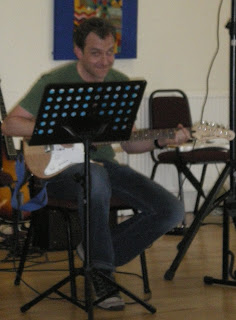 After what seemed like an age, the backing track kicked in. This was it! Now the first note was fine. I think as first notes go it was faultless. I had nothing against the first note. It was the second note and the vast majority of all the notes that followed that seemed to cause the problem. (As Eric Morecambe once noted: "...I was playing all the right notes, but not necessarily in the right order!"). Once I'd missed the timing on the second note it went from bad to worse. I might have hit the occasional note after that but probably more by fluke than by design. It was indeed a guitar fiasco.
As the backing track came to an end, the very sympathetic audience gave a cheer and a round of applause. They were probably just pleased it was all over. Either that or they were being sarcastic. I went back to sit next to Rachel in the audience who, along with my mum and dad who had come along to give support, said she was very proud of me. She was probably just pleased it was all over. Either that or she was being sarcastic.
The rest of the concert I could actually enjoy now that my bit was out of the way. The guy on after me, Daryl, was perhaps even more nervous than me. But then he was even older than me. Which goes to show that it's adulthood that seems to bring out the performance anxiety in us. Still, Daryl held it together better than I did. His "Theme for Young Lovers", though a little nervey, was very good. The highlights of the concert were Charlie Powell, with is own composition (a Jean-Michel Jarre type keyboard fest) and Andrew Wignall, with a superb rendition of "Le Onde" on the piano. Both aged 16 or so, they were as confident as anything, and I mention their full names here so that when they become famous you can say you heard it here first.
All in all, a good concert apart from the contribution from the guy with the green face who liked football but not maths. It was his first concert, but I think it will also be his last.
As some of you will know I took up learning to play the guitar last year and signed up for weekly lessons with the Yamaha Music School. Every so often the school organises a concert for the students as an opportunity to 'showcase' their musical skills for friends and family. I said I'd play something, and opted for playing "Walk Don't Run", an instrumental written by jazz guitarist Johnny Smith (and apparently a hit for both the Ventures and the John Barry Seven). As it was the first piece in the Guitar Encounters Book 2 (yes, Book 2... be impressed!), and we'd been learning and practising it in class for what seemed like ages, it seemed the obvious choice. By the morning of the concert, last Sunday, I think I could play it pretty well, even though I do say so myself. With or without the backing track.
In the afternoon, we battled through a torrential downpour to the community centre where the concert was to be held. I was already feeling nervous, but as we went in to the hall, I became really nervous (possibly even more so than before the Skeptics in the Pub talk!). A quick look through the programme revealed that my slot was about half way through the proceedings, which meant about another nerve-wrangling half-hour of waiting but at least I could get a feeling of how good the other performances were before me. That didn't help. They were all really good, and what's more we're talking kids aged between about 6 and 12 years old here. (For the record, I'll be 38 next month.) They would each just get up, go to their instrument of choice (which was mainly the piano but there were a few guitar players), play their piece, and return to their proud parents in the audience. I was hoping for a few cock ups. Just one or two that made enough of a mess if it to lower the audience's expectations. No such luck. They were all pretty much note perfect. Gits.
Before each student's performance we were given a bit of background about the performer: "As well as playing the piano Sara is 8 years old and likes football and maths...", "Tommy, aged 6, is fluent in Spanish and German, and has a black belt in Aikido...", "Emily, 12, has a degree in Nuclear Physics and has built her very own particle accelerator in her back garden...". You get the idea.
My palms were sweating. Just two more to go then it would be my turn... Marc with "Minuet by Mozart" (show off), followed by Cara with "The Camel" (should be interesting), and then Matthew with "Walk, Don't Run". I felt sick. From the other side of the hall, Vernon, my guitar teacher who would introduce me, looked over and mouthed "are you okay?". He could probably sense my nervousness by the fact that my face was now almost the same colour as my green t-shirt. I looked back at him and shook my head.
Marc concluded his near perfect rendition of Mozart's Minuet. Vernon walked to the front and announced "Next we have Matthew...". Eh? What about Cara? Where's Cara? I was looking forward to hearing Cara play "The Camel"! Cara must have bottled it. Either that or she was unable to make it because her Karate lesson had ran over. Either way, it was now my turn. I took to the stage, sat down and picked up the guitar. Vernon continued, "...this is Matthew's first time playing guitar in public, ever!", "...and I'm very, very nervous!" I quickly added. As if it wasn't already obvious how nervous I was, "Oh, and I like football but I don't like maths".
 After what seemed like an age, the backing track kicked in. This was it! Now the first note was fine. I think as first notes go it was faultless. I had nothing against the first note. It was the second note and the vast majority of all the notes that followed that seemed to cause the problem. (As Eric Morecambe once noted: "...I was playing all the right notes, but not necessarily in the right order!"). Once I'd missed the timing on the second note it went from bad to worse. I might have hit the occasional note after that but probably more by fluke than by design. It was indeed a guitar fiasco.
As the backing track came to an end, the very sympathetic audience gave a cheer and a round of applause. They were probably just pleased it was all over. Either that or they were being sarcastic. I went back to sit next to Rachel in the audience who, along with my mum and dad who had come along to give support, said she was very proud of me. She was probably just pleased it was all over. Either that or she was being sarcastic.
The rest of the concert I could actually enjoy now that my bit was out of the way. The guy on after me, Daryl, was perhaps even more nervous than me. But then he was even older than me. Which goes to show that it's adulthood that seems to bring out the performance anxiety in us. Still, Daryl held it together better than I did. His "Theme for Young Lovers", though a little nervey, was very good. The highlights of the concert were Charlie Powell, with is own composition (a Jean-Michel Jarre type keyboard fest) and Andrew Wignall, with a superb rendition of "Le Onde" on the piano. Both aged 16 or so, they were as confident as anything, and I mention their full names here so that when they become famous you can say you heard it here first.
All in all, a good concert apart from the contribution from the guy with the green face who liked football but not maths. It was his first concert, but I think it will also be his last.
Wednesday, 7 May 2008
Mud, Glorious Mud
The British summer just might save us from the Ugg. I'm not talking about the warm weather actually putting girls off wearing the fur-lined boots. No, I don't think that's possible. I'm talking about the mud. Hopefully by the end of the summer, all Ugg boots in existence will be forever ruined by the muddiness of the summer festivals. We can but hope.
Monday, 5 May 2008
The Last Lecture
I think my dad might be psychic. A couple of days ago he was asking me about the guy who did the book The Last Lecture. "The one you blogged about..." he said. "Er, I haven't written a blog about him... yet. I was thinking of writing a blog about him" I replied. In fact, I had been watching Randy Pausch's "The Last Lecture" on YouTube that same day, and here I am writing a blog about him. So, my only conclusion is that my dad must be psychic.*
I had come across the book The Last Lecture by Randy Pausch and Jeff Zaslow in a book shop a couple of days before. I hadn't bought the book, nor had I even considered stealing it, but I did scan the inside front cover. It was inspired by an actual lecture given by Pausch at Carnegie Mellon University in September 2007 which was part of a lecture series in which University professors are invited to give a lecture as though it was the last lecture they were to give. What would they say to their students in their last ever lecture? For Pausch this was more than a conceptual exercise. He had been diagnosed with Pancreatic Cancer and was told by doctors he had months to live. As far as he was concerned this really could be his last lecture.
My friend Simon at work the next day alerted me to the fact that the lecture was available on YouTube having heard an item about it on the radio that morning. So, having now watched the lecture, I thought I'd embed it here for you guys (note: it's about 76 minutes long... short excerpts are also available on YouTube). It's called "Really Achieving Your Childhood Dreams":
Having been given only a few months to live, Randy Pausch is still with us. His website is here, where there is also a link to updates regarding his progress.
*It turns out my dad had confused Prof Randy Pausch with Prof Robert Solomon about whom I have blogged. I still think he might be psychic.
I had come across the book The Last Lecture by Randy Pausch and Jeff Zaslow in a book shop a couple of days before. I hadn't bought the book, nor had I even considered stealing it, but I did scan the inside front cover. It was inspired by an actual lecture given by Pausch at Carnegie Mellon University in September 2007 which was part of a lecture series in which University professors are invited to give a lecture as though it was the last lecture they were to give. What would they say to their students in their last ever lecture? For Pausch this was more than a conceptual exercise. He had been diagnosed with Pancreatic Cancer and was told by doctors he had months to live. As far as he was concerned this really could be his last lecture.
My friend Simon at work the next day alerted me to the fact that the lecture was available on YouTube having heard an item about it on the radio that morning. So, having now watched the lecture, I thought I'd embed it here for you guys (note: it's about 76 minutes long... short excerpts are also available on YouTube). It's called "Really Achieving Your Childhood Dreams":
Having been given only a few months to live, Randy Pausch is still with us. His website is here, where there is also a link to updates regarding his progress.
*It turns out my dad had confused Prof Randy Pausch with Prof Robert Solomon about whom I have blogged. I still think he might be psychic.
Sunday, 27 April 2008
Oops I did it again!
 Oh dear. I've done it again... I seem to have gone and registered to take part in this year's Great Manchester 10K Run. You would have thought I might have learned my lesson from last year, but apparently not. That's me in the picture trying to look all smug after dragging myself around 10 km of Manchester's City Centre last year. Forced smile, you say?
It is, of course, all in a good cause. As with last year, the charity I am running for is BLISS, the premature baby charity. Since last year's run, I became a father again to a cutesy little girl, Freya, who was 5 weeks' premature. Fortunately, Freya did not need to go into the special care baby unit, but many premature babies do need such care. For example, my son Ross was born 11 weeks' premature and needed to be in hospital for the first 5 months of his life. BLISS campaigns for improvements in neonatal care and supports parents.
If you would like to donate a quid or two (and I'd be eternally grateful if you did), please click on the 'Donate' button on the image to the right of this page (I believe it's called a 'widget') to go to my justgiving fundraising page!
Saturday, 5 April 2008
It's Just a Ride
The world is like a ride at an amusement park.
And when you choose to go on it, you think that
it's real because that's how powerful our minds are.
And the ride goes up and down and round and round.
It has thrills and chills, and it's very brightly coloured,
and it's very loud and it's fun, for a while.
Some people have been on the ride for a long time,
and they begin to question - is this real, or is this just a ride?
Bill Hicks 1961-1994
Thursday, 6 March 2008
A Metaphor for Life?
Over the past couple of weeks I have given three talks on the subject of luck and destiny. Actually, I gave much the same talk three times to different audiences under a slightly different title each time. The only person to sit through all three talks was Rachel (sorry Rach!). To be fair, I did make some changes each time, adding bits and dropping other bits as appropriate, so I think even Rachel would agree that the third talk was probably the best of the three.
Anyway, the first and the third talks I had known about for some time. The first was a talk as part of the Invited Speaker Series at the Anomalistic Psychology Research Unit (APRU) at Goldsmiths College, University of London. I had been invited to give a talk by Professor Chris French, head of the APRU, who I have known for around 15 years (!) and with whom I came close to studying for a PhD before starting my PhD on the psychology of luck at the University Hertfordshire. The third talk was at Liverpool Hope University, where I have worked for the past eight years or so, and was part of the University's Foundation Hour programme. Foundation Hour is held 1-2pm each Wednesday and is an opportunity for the University's staff and students to come together and listen to an inspiring and uplifting talk (!).
 The second talk of the three, however, was a last-minute arrangement. It was for a group called 'Skeptics in the Pub', which meet each month in London in (no surprises here...) a pub. I was asked to stand in for a speaker who was unable to make it, and so I agreed. For some reason, I was really nervous before giving this talk. And I mean really nervous. As it turned out, it seemed to go fine. However, the reason I mention it here is because of an email I received a day or so after the talk from someone who had been there, and who had subsequently taken a look at this blog. He, like me, had only recently started to learn to play the guitar, although he's now been learning for about 4 years. In his words (and I'm hoping he won't mind me including them here):
Anyway, the first and the third talks I had known about for some time. The first was a talk as part of the Invited Speaker Series at the Anomalistic Psychology Research Unit (APRU) at Goldsmiths College, University of London. I had been invited to give a talk by Professor Chris French, head of the APRU, who I have known for around 15 years (!) and with whom I came close to studying for a PhD before starting my PhD on the psychology of luck at the University Hertfordshire. The third talk was at Liverpool Hope University, where I have worked for the past eight years or so, and was part of the University's Foundation Hour programme. Foundation Hour is held 1-2pm each Wednesday and is an opportunity for the University's staff and students to come together and listen to an inspiring and uplifting talk (!).
 The second talk of the three, however, was a last-minute arrangement. It was for a group called 'Skeptics in the Pub', which meet each month in London in (no surprises here...) a pub. I was asked to stand in for a speaker who was unable to make it, and so I agreed. For some reason, I was really nervous before giving this talk. And I mean really nervous. As it turned out, it seemed to go fine. However, the reason I mention it here is because of an email I received a day or so after the talk from someone who had been there, and who had subsequently taken a look at this blog. He, like me, had only recently started to learn to play the guitar, although he's now been learning for about 4 years. In his words (and I'm hoping he won't mind me including them here):
Congrats on the guitar lessons. I'm 33 and started guitar when I was almost 29. Stick with it - it gets better after a year or so. Eventually there's a shift when you stop feeling like you're playing catch-up to the demands of the tune, and instead suddenly you really feel like you're driving each note. It's the coolest thing.Not only did these words reassure me that learning the guitar gets easier after a year or so (and I am finding this), but they also made me think of them as a possible metaphor for life... that is, there comes a time where you don't feel as though you're going through life trying to keep up with the pace being dictated to you by others ("playing catch-up to the demands of the tune"), but instead you start feeling as though you're in control of your life ("suddenly you really feel like you're driving each note"). And when that happens, like the man says, it's the coolest thing.
Monday, 25 February 2008
The Luck Doctors
It may come as a surprise to some of you to learn that I actually have a PhD ("oooh... get him!" I hear you cry). Believe me, it sometimes still surprises me. But 10 years ago I was awarded a PhD by the University of Hertfordshire, thereby becoming a "Dr". Perhaps even more surprising was the topic of my PhD... luck! The full title was Perceptions of One's Own Luck: The Formation, Maintenance and Consequences of Perceived Luckiness. A bit of a mouthful, I know, but PhD titles are supposed to sound clever and obscure, aren't they?
It was a study of the 'psychology of luck', and examined people's beliefs about luck and explored the psychological differences between 'lucky' and 'unlucky' people. Lucky people were those people who felt that seemingly chance events tended to work out in their favour, whilst unlucky people were those who felt they tended to work out against them. The aim of the project was to discover why some people believe themselves to be lucky whilst others believe themselves to be unlucky. Do these people really lead very different lives? And if so, is there any psychological reasons why this might be the case? Or do 'lucky' and 'unlucky' people actually lead rather similar lives but differ in the ways in which they make sense of the events that happen to them?
The research was the brainchild of Dr (now Professor!) Richard Wiseman who, in collaboration with Dr Peter Harris, had obtained a research grant from the Leverhulme Trust, a charitable organisation that supports research in a variety of areas. I was employed as the Research Assistant working on the project, and took the opportunity to register for a PhD at the same time with Richard and Peter as my supervisors. Together, we interviewed and collected other psychological data from self-perceived lucky and unlucky people for over three years.
The picture that emerged was quite remarkable. Lucky and unlucky people, on the whole, were very different from each other. For example, while lucky people tended to be far more optimistic, and more extraverted individuals, unlucky people were more likely to be anxious and experience depressed mood states. Moreover lucky and unlucky people differed in the extent to which they remembered the positive and negative events in their lives, and also in the way they interpreted events. Lucky people found it easier to remember events they considered lucky than unlucky events, and were more likely to label events as lucky in the first place. This latter point is nicely illustrated by following little experiment:
 As I say, it is now 10 years since I was awarded a PhD for my contribution to this project on the psychology of luck. In the years since then my interest in this topic faded somewhat as I pursued other lines of research. In the meantime, my PhD supervisor, and the instigator of the 'luck project', Richard Wiseman, went on to conduct a whole lot more research on the psychology of luck which culminated in a best-selling book called The Luck Factor (Arrow Books, 2004) in which Richard identified four main principles that could "change your luck - and your life"!
The funny thing was that by the time this book was published I had developed a healthy lack of interest in whole 'luck' research. If anything, I was probably one of the most cynical about the ideas presented in this book. It was one thing to identify the various differences between self-perceived lucky and unlucky people, but another thing to suggest that you could change your luck by changing the way you think!
What is perhaps even funnier is that, not only am I now finding myself being drawn back to the ideas talked about by Richard in The Luck Factor, but I am also becoming convinced that Richard has barely scraped the surface. I've got a feeling that there could well be plenty more to discover about the psychology of luck, fate and destiny!
It was a study of the 'psychology of luck', and examined people's beliefs about luck and explored the psychological differences between 'lucky' and 'unlucky' people. Lucky people were those people who felt that seemingly chance events tended to work out in their favour, whilst unlucky people were those who felt they tended to work out against them. The aim of the project was to discover why some people believe themselves to be lucky whilst others believe themselves to be unlucky. Do these people really lead very different lives? And if so, is there any psychological reasons why this might be the case? Or do 'lucky' and 'unlucky' people actually lead rather similar lives but differ in the ways in which they make sense of the events that happen to them?
The research was the brainchild of Dr (now Professor!) Richard Wiseman who, in collaboration with Dr Peter Harris, had obtained a research grant from the Leverhulme Trust, a charitable organisation that supports research in a variety of areas. I was employed as the Research Assistant working on the project, and took the opportunity to register for a PhD at the same time with Richard and Peter as my supervisors. Together, we interviewed and collected other psychological data from self-perceived lucky and unlucky people for over three years.
The picture that emerged was quite remarkable. Lucky and unlucky people, on the whole, were very different from each other. For example, while lucky people tended to be far more optimistic, and more extraverted individuals, unlucky people were more likely to be anxious and experience depressed mood states. Moreover lucky and unlucky people differed in the extent to which they remembered the positive and negative events in their lives, and also in the way they interpreted events. Lucky people found it easier to remember events they considered lucky than unlucky events, and were more likely to label events as lucky in the first place. This latter point is nicely illustrated by following little experiment:
Imagine you are waiting to be served in a bank when an armed robber enters and fires a shot. The bullet hits you in the arm.How lucky or unlucky would you regard this event? We asked people to rate the event (along with other events) on a scale from -3 (very unlucky) to +3 (very lucky), and found that there was a wide range of opinions regarding the luckiness of events such as this. While some people consider this event to be unlucky, others consider it to be actually rather lucky. In both cases, the judgement of how lucky or unlucky the event is made by imagining how the event might have been different from what happened. For example, those who consider the event to be unlucky can easily imagine a scenario where the bullet might have missed you altogether and so see it as being rather unlucky to have been hit by the bullet. Meanwhile, people who see the event as lucky are imagining a situation where the bullet might have hit you in the chest causing much more damage, perhaps even killing you. By comparison, a bullet in the arm is actually quite lucky. This just goes to show that an event is not necessarily lucky or unlucky in itself, it becomes perceived as such by the person making the observation. What was particularly interesting was that lucky people were more likely to rate the event as lucky while unlucky people were more likely to rate it as unlucky.
As I say, it is now 10 years since I was awarded a PhD for my contribution to this project on the psychology of luck. In the years since then my interest in this topic faded somewhat as I pursued other lines of research. In the meantime, my PhD supervisor, and the instigator of the 'luck project', Richard Wiseman, went on to conduct a whole lot more research on the psychology of luck which culminated in a best-selling book called The Luck Factor (Arrow Books, 2004) in which Richard identified four main principles that could "change your luck - and your life"!The funny thing was that by the time this book was published I had developed a healthy lack of interest in whole 'luck' research. If anything, I was probably one of the most cynical about the ideas presented in this book. It was one thing to identify the various differences between self-perceived lucky and unlucky people, but another thing to suggest that you could change your luck by changing the way you think!
What is perhaps even funnier is that, not only am I now finding myself being drawn back to the ideas talked about by Richard in The Luck Factor, but I am also becoming convinced that Richard has barely scraped the surface. I've got a feeling that there could well be plenty more to discover about the psychology of luck, fate and destiny!
Sunday, 10 February 2008
How To Be Free
 I hope my brother isn't reading this. Don't get me wrong, it's not that I don't want him to be 'free'. In fact, quite the opposite, which is why I bought him Tom Hodgkinson's book How To Be Free for Christmas. The only thing is, I haven't actually given him the book yet as I haven't seen him since before Christmas.
However, this has given me a chance to have a flick through the book myself (taking care not to crease the cover of course!) and it's full of some worthy advice. For example, in a chapter called 'Reject Career and All Its Empty Promises' Hodgkinson urges us to forget about the idea of chasing a career, but instead encourages us to find our vocation, our calling, which should be something that you enjoy doing as well as earn you a living:
We have a duty to look into our hearts and discover our vocation, find our gift. Once we have done this, we will find that other parts of our life follow quite naturally... ... And how do you find your vocation, your gift? The answer is simply to do nothing for as long as you possibly can. In the same way that wise gardeners advise that the first step when taking over a new garden is to do nothing for a year, in order to see what grows there and only then to design your own unique, useful and beautiful garden, so I would advise taking a few months off, or even a year, if you can manage it. (p. 48-49)
I like that idea. And it makes much sense. If you want to find out what you really want to do with your life, then I guess taking a little time out to discover what this might be is something to be encouraged. This sentiment continues in another chapter called 'Cast Off Your Watch', in which he urges us to... er, cast off our watches and stop being a slave to time:
Do less. Add space. Cut down on your scheduled visits and meetings to an absolute bare minimum to make way for the more enjoyable and life-affirming 'things that just happen'. When you let things happen to you, life starts happening too. So, allow giant gaps between appointments. Allow giant gaps in your life, because your life is in the gaps. (p.81)
All good stuff, and reminds me of the immortal words of John Lennon who said that 'Life is what happens when you're busy making other plans'. But then again (as Tim in The Office notes) John Lennon also said 'I am the Walrus, I am the Egg Man', so who knows what to make of that.
Still, Tom Hodgkinson's book contaains some good advice. Just don't tell my brother. Not yet anyway.
Saturday, 9 February 2008
Garroping Gourmet
One of the themes of this blog is that nothing is random. I guess this post just might be the exception to prove the rule. This morning, while watching Saturday Kitchen on the BBC, I got talking to Rachel about the Galloping Gourmet who was a TV chef from my youth who used to run on to the set, jumping over chairs, and would cook a meal for himself and a member of the studio audience.
As I couldn't remember the guy's name, I turned to our friend Google. It turns out he was called Graham Kerr (I had been saying he was called Robert something...). Anyway, our other friend YouTube provided us with a few clips from the show. It was the clip copied below that I found myself laughing out loud at for some reason, and so I include it here. It lasts about 9 minutes, but it was the first few minutes (after the titles) that had me laughing.
As I couldn't remember the guy's name, I turned to our friend Google. It turns out he was called Graham Kerr (I had been saying he was called Robert something...). Anyway, our other friend YouTube provided us with a few clips from the show. It was the clip copied below that I found myself laughing out loud at for some reason, and so I include it here. It lasts about 9 minutes, but it was the first few minutes (after the titles) that had me laughing.
Uggly boots
 I think I've got to get myself a pair of Ugg boots. They are clearly the footwear of choice this season. Last year it was Heelys, but this year it's the Ugg. Every third person seems to be wearing a pair. But am I the only one who thinks they look ever so slightly like slippers for the infirm?
Subscribe to:
Posts (Atom)